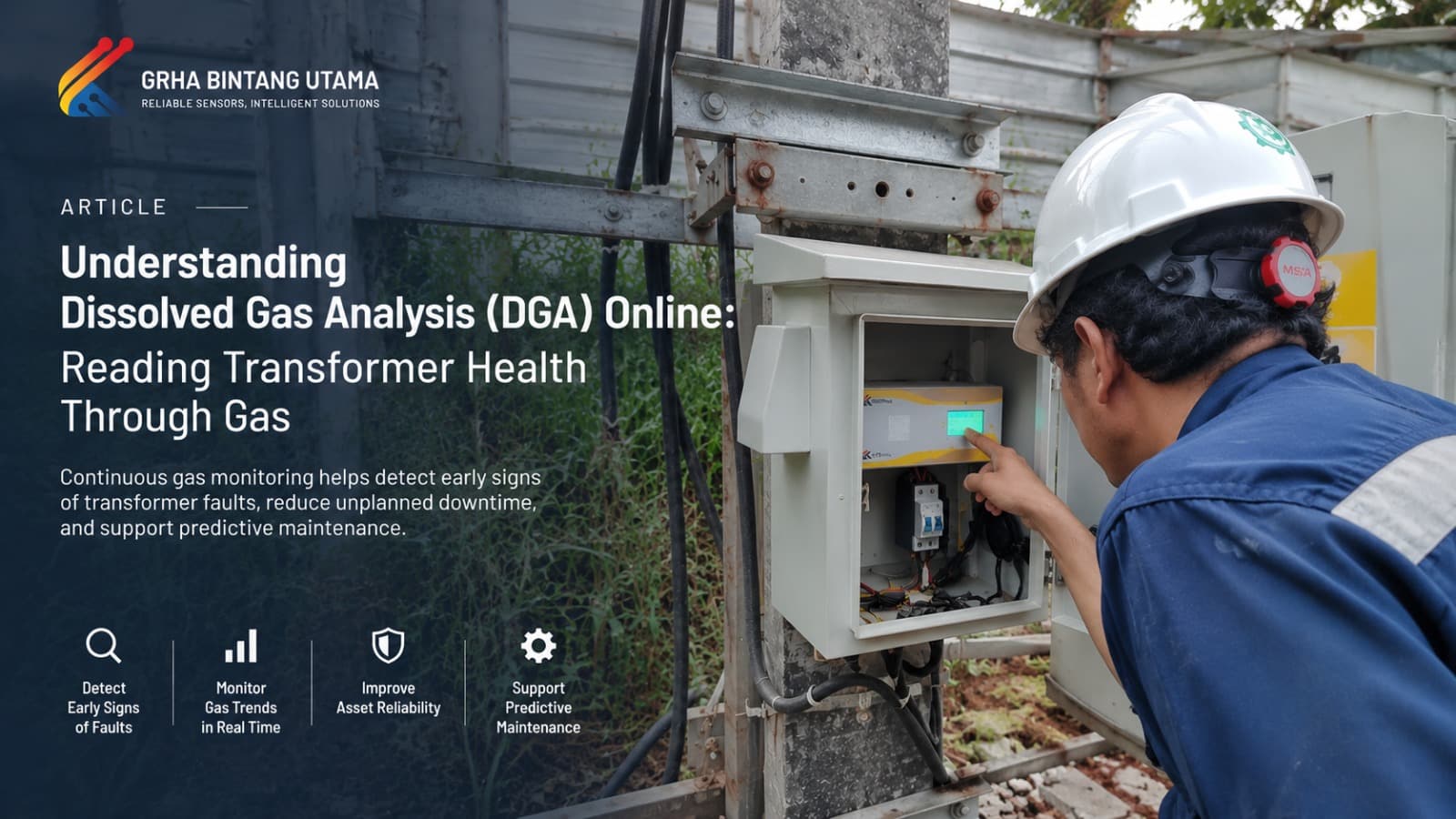
Dissolved Gas Analysis (DGA) Online: Reading Transformer Health Through Gas in Real Time
Author
Understanding Dissolved Gas Analysis (DGA) Online: Reading Transformer “Health” Through Gas
Power transformers are among the most critical assets in an electrical system. In industrial complexes, mining operations, power plants, data centers, high-rise buildings, manufacturing facilities, and transportation infrastructure, transformer failure can create a chain reaction: electrical supply is interrupted, production stops, equipment loses power, emergency maintenance is required, and operational costs increase.
The challenge is that the internal condition of a transformer cannot always be determined simply by looking at the outside.
Visually, a transformer may appear normal. There may be no obvious oil leakage, no unusual external temperature, no abnormal noise, and the unit may still be operating normally.
However, inside an oil-filled transformer, certain thermal and electrical activities can produce gases. These gases may dissolve in the insulating oil and provide valuable information about what is happening inside the equipment.
This is where Dissolved Gas Analysis (DGA) Online becomes important.
DGA has been used for decades to help detect and classify faults in transformers. CIGRE notes that one of the key advantages of online DGA monitoring is its higher sampling frequency compared with traditional offline methods, providing better visibility of changes over time.
In simple terms, the process can be illustrated as:
TRANSFORMER OIL → DISSOLVED GAS → DGA MONITOR → ANALYSIS → TREND → ALARM → ENGINEERING DECISION
The gases become a form of “evidence” describing activity inside the transformer.
But how does DGA Online actually work? Which gases are monitored? And why are gas trends so valuable for maintenance?
Let us examine it in detail.
1. What Is Dissolved Gas Analysis (DGA)?
Dissolved Gas Analysis, or DGA, is a diagnostic method used to analyze gases dissolved in the insulating fluid of a transformer.
Under certain conditions, heat, electrical discharge, and material degradation can produce different gases.
These gases then dissolve in the transformer oil.
By measuring the type, concentration, and development of those gases over time, engineers can gain useful information about the transformer's internal condition.
IEEE C57.104-2019 is one of the most widely recognized references in this field. It covers the theory of gas generation in transformers, the purpose and use of DGA, data quality and limitations, interpretation methods, fault type definitions, and practical interpretation examples.
DGA is therefore not simply a question of:
“Is gas present or not?”
A more useful analysis considers:
which gas is present + how much is present + how the concentration is changing + how quickly it changes + how the gases relate to each other + the transformer's operating condition.
All of this information becomes part of the diagnostic process.
2. Why Do Gases Form Inside a Transformer?
Oil-filled transformers use insulating fluid as an important part of both electrical insulation and thermal management.
During normal operation, internal materials are exposed to electrical and thermal stress.
When abnormal thermal stress or electrical stress occurs, insulating materials can begin to decompose and produce gases.
The type and pattern of gas formation can vary depending on the mechanism involved.
This is the fundamental principle behind DGA:
specific internal condition → specific gas pattern → gas pattern is analyzed → engineers gain an indication of internal transformer condition.
However, gas interpretation should not be based on a single gas alone.
Engineers need to evaluate the complete gas profile together with the transformer’s operating history and other relevant parameters.
3. Which Gases Are Monitored by DGA?
Modern multi-gas DGA systems can measure several gases individually.
For example, some commercial online DGA monitors can measure nine gases: hydrogen, methane, ethane, ethylene, acetylene, carbon monoxide, carbon dioxide, nitrogen, and oxygen, along with moisture in oil.
Several important diagnostic gases commonly discussed in transformer analysis include:
Hydrogen – H₂
Hydrogen can be generated under several fault conditions and is often an important gas in transformer monitoring.
Because it can be associated with more than one type of condition, H₂ should not be interpreted by itself.
Methane – CH₄
Methane is a hydrocarbon gas that can form due to decomposition of insulating oil under certain thermal conditions.
Ethane – C₂H₆
Ethane is another hydrocarbon gas that can provide additional information related to thermal activity in insulating oil.
Ethylene – C₂H₄
Ethylene is commonly associated with higher-temperature thermal activity and can become important in evaluating thermal faults.
Acetylene – C₂H₂
Acetylene is especially important because its generation may be associated with high-energy electrical discharge such as arcing.
Its presence should always be evaluated together with its concentration, trend, other gases, transformer history, and operating conditions.
Carbon Monoxide – CO
Carbon monoxide can be associated with degradation of cellulose-based insulation.
Carbon Dioxide – CO₂
Carbon dioxide can also help provide information related to the condition of cellulose insulation when evaluated together with other parameters.
In some monitoring systems, nitrogen and oxygen are also measured to provide additional information about transformer oil systems and internal conditions.
4. Why Is It Called “Dissolved” Gas Analysis?
The word dissolved is critical.
Gases generated inside a transformer do not necessarily escape immediately or become visible.
A significant portion can dissolve in the insulating oil.
That is why transformer oil can act as a diagnostic medium.
Think of the oil as an information carrier.
The transformer operates.
An abnormal condition develops.
Materials react.
Gas is generated.
The gas dissolves in the oil.
DGA measures that gas.
The data can then help engineers understand what may be happening internally.
This concept makes DGA particularly valuable for transformer condition assessment.
5. Offline DGA vs Dissolved Gas Analysis (DGA) Online
Traditionally, DGA is performed by collecting oil samples.
Technicians visit the transformer, take an oil sample following proper procedures, and send the sample for analysis using suitable laboratory equipment or portable onsite instruments.
This approach remains highly relevant.
Portable equipment can also perform DGA and moisture analysis directly onsite, providing rapid diagnostic information.
However, there is an important difference between periodic sampling and online monitoring.
Offline DGA
Typical workflow:
Oil Sampling → Transport → Laboratory or Portable Analysis → Result → Interpretation
Its strength lies in detailed analysis at a specific point in time.
However, the result is fundamentally a snapshot of transformer condition when the sample was taken.
DGA Online
Typical workflow:
Transformer → Online DGA Monitor → Repeated Measurements → Data → Trend → Alarm → Dashboard
The system performs measurements automatically at much shorter intervals than periodic laboratory testing.
The key difference is:
Offline DGA = Snapshot
Online DGA = Trend Visibility
In condition monitoring, the ability to see trends over time can be extremely valuable.
6. Why Is a Trend More Important Than a Single Number?
Imagine two transformers showing the same gas concentration today.
Does that mean they have the same condition?
Not necessarily.
Transformer A may have remained at that concentration for the last twelve months and be relatively stable.
Transformer B may have increased sharply over the past three days.
The current number is the same.
But the rate of change is different.
This is one of the main reasons DGA Online is valuable.
It allows engineers to observe:
- current gas values;
- previous gas values;
- daily trends;
- weekly trends;
- monthly trends;
- rate of gas generation;
- correlation with transformer load;
- correlation with temperature;
- specific operating events.
Some online DGA systems can even increase measurement frequency when gas concentrations exceed predefined caution or alarm settings.
Engineers are therefore not only asking:
“What is the gas concentration today?”
They are also asking:
“How has this gas changed over the last 24 hours, one week, one month, or one year?”
7. How Does DGA Online Work?
In general, Dissolved Gas Analysis (DGA) Online is connected to the transformer oil system.
The architecture can differ depending on technology and manufacturer, but the process typically includes several stages.
Stage 1 – Oil Interface
The monitoring system connects to the transformer so the insulating oil becomes the measurement source.
Stage 2 – Gas Extraction or Measurement
The system uses a process that allows the dissolved gas content to be detected or measured.
Stage 3 – Gas Detection
The gases are measured using the sensing technology incorporated into the monitor.
Some online DGA systems, for example, use Photo-Acoustic Spectroscopy (PAS).
Stage 4 – Data Processing
The measured results are converted into gas concentration values, usually expressed in ppm, or parts per million.
Stage 5 – Data Storage
The data is stored so current measurements can be compared with historical data.
Stage 6 – Trend Analysis
Software displays the development of gas concentrations over time.
Stage 7 – Alarm Generation
If the monitored values meet predefined alarm conditions, the system can generate notifications.
Stage 8 – Engineering Evaluation
Engineers evaluate the condition and determine whether further action is required.
The complete workflow becomes:
TRANSFORMER OIL → DGA SENSOR/MONITOR → GAS MEASUREMENT → DATA → TREND ANALYSIS → ALARM → ENGINEER
8. Turning Gas Data into Diagnosis
The true value of DGA does not come from measuring gas concentration alone.
Its real value lies in interpretation.
Several diagnostic methods are commonly used in the industry to help evaluate gas patterns.
One widely known method is the Duval Triangle.
Some modern DGA monitoring platforms integrate Duval Triangle diagnostics directly into their analysis software.
Other interpretation approaches may consider:
- individual gas concentrations;
- gas ratios;
- total dissolved combustible gas;
- gas generation rate;
- historical trends;
- operating conditions;
- transformer type;
- transformer age;
- load history.
DGA should therefore not be treated as a simple rule such as:
“Gas X is high, therefore component Y is definitely damaged.”
Proper diagnosis requires context.
9. What Can Gas Patterns Indicate?
Conceptually, DGA can help identify indications of several internal transformer conditions.
Thermal Faults
Overheating of oil or internal materials can produce different hydrocarbon gas patterns depending on temperature and energy level.
Partial Discharge
Low-energy electrical discharge may generate specific gas patterns.
Arcing or High-Energy Discharge
High-energy electrical discharge can produce a different combination of gases, with acetylene receiving particular attention.
Cellulose Degradation
Carbon monoxide and carbon dioxide may provide information relevant to degradation of cellulose-based insulation.
However, gas data should always be treated as diagnostic evidence, not as a final diagnosis by itself.
This is also why recognized standards such as IEEE C57.104 discuss both the interpretation and limitations of DGA.
10. Single-Gas vs Multi-Gas DGA Monitoring
Not all DGA Online systems offer the same capability.
In general, there are two broad approaches.
Single-Gas Monitoring
This type of system monitors a specific gas or a combined gas parameter as an early indicator.
Its advantages can include simpler configuration and lower complexity for certain applications.
Multi-Gas Monitoring
This type measures multiple gases individually.
Its greatest advantage is richer diagnostic data.
Modern monitoring platforms can be configured for three gases, five gases, or nine gases plus moisture, depending on the application.
The correct choice should be based on factors such as:
Asset Criticality + Consequence of Failure + Transformer Value + Operational Importance + Diagnostic Requirement + Budget
A transformer supplying a highly critical process may require a different monitoring strategy from a low-risk transformer.
11. DGA Online and Moisture Monitoring
In addition to dissolved gases, moisture in oil is an important transformer condition parameter.
Moisture can influence insulation performance.
For this reason, many online DGA monitors also include moisture measurement.
Some systems can measure multiple gases in ppm while simultaneously monitoring moisture in %RH and ppm.
Combining:
DGA + Moisture + Temperature + Load
provides engineers with a more complete picture than evaluating a single parameter alone.
12. Integrating DGA with Other Transformer Sensors
DGA Online should not be considered the only source of transformer condition information.
A more comprehensive transformer monitoring system may integrate:
- DGA;
- moisture;
- oil temperature;
- winding temperature;
- electrical load;
- current;
- voltage;
- bushing monitoring;
- cooling system status;
- OLTC monitoring;
- partial discharge;
- oil level;
- environmental sensors.
Some transformer monitoring platforms also provide additional inputs for load, oil temperature, cooling systems, OLTC, and bushing monitoring.
The information can then be consolidated into a single monitoring platform or dashboard.
13. DGA Dashboard: Turning PPM into Useful Information
Imagine an engineer having to review thousands of ppm values every day.
Without effective visualization, the raw data would be difficult to use.
This is why the dashboard becomes an important component of DGA Online.
A DGA monitoring dashboard may display:
Transformer Status
NORMAL / WARNING / CRITICAL
Gas Concentrations
H₂ – CH₄ – C₂H₆ – C₂H₄ – C₂H₂ – CO – CO₂
Moisture
ppm / %RH
Gas Trend
24 Hours / 7 Days / 30 Days / 1 Year
Rate of Change
How quickly gas concentration is changing.
Alarm History
Previous warnings and alarms.
Additional Transformer Parameters
Load, temperature, cooling system status, and other integrated measurements.
The dashboard transforms:
RAW DATA → TREND → INFORMATION → ENGINEERING INSIGHT
14. Early Warning: One of the Main Advantages of DGA Online
Why do organizations invest in online monitoring?
One major reason is time.
Periodic oil sampling can provide highly valuable information, but transformer conditions may change between scheduled tests.
Online monitoring reduces this blind spot by collecting data more frequently.
CIGRE has recognized online DGA monitoring as a valuable tool for detecting incipient faults and supporting transformer condition assessment.
When gas trends begin to change, the system can provide earlier visibility.
Engineers then gain additional time to:
- verify the data;
- increase monitoring frequency;
- conduct additional oil sampling;
- perform inspections;
- carry out electrical testing;
- consult transformer specialists;
- plan maintenance activities;
- prepare a shutdown if necessary.
The value of online monitoring is not simply the alarm itself.
Its value is additional decision-making time.
15. DGA Online Supports Predictive Maintenance
Traditional maintenance is often time-based.
For example:
Every six months → inspection
Every twelve months → oil test
At scheduled intervals → preventive maintenance
This approach remains useful.
However, online condition monitoring adds a new dimension:
What is the actual condition of the asset right now?
By analyzing DGA history, engineers can observe how transformer condition changes over time.
This supports a transition from:
Reactive Maintenance
Action is taken after a problem occurs.
↓
Preventive Maintenance
Action is taken according to schedule.
↓
Condition-Based Maintenance
Action is considered based on actual equipment condition.
↓
Predictive Maintenance
Historical data and trends are used to help anticipate how conditions may develop and when intervention may become necessary.
Online DGA monitoring can become an important source of information in this maintenance strategy.
16. How DGA Online Can Help Reduce Downtime Risk
Transformer failure can create significant business consequences.
The cost is not limited to the transformer itself.
Organizations may face:
- production downtime;
- emergency maintenance;
- temporary power requirements;
- overtime;
- spare part costs;
- specialist mobilization;
- production losses;
- damage to connected equipment;
- operational delays.
DGA Online cannot guarantee that every transformer failure will be prevented.
However, it can improve a company’s ability to detect changing asset conditions earlier.
This can make the difference between:
Unplanned Failure
and
Planned Intervention
From an operational perspective, that difference can be substantial.
17. Which Industries Need Dissolved Gas Analysis (DGA) Online?
DGA Online is particularly relevant when transformer failure carries a high operational or financial consequence.
Mining
Transformers may supply crushers, conveyors, processing plants, pumping systems, workshops, and supporting infrastructure.
Manufacturing
Transformer failure can interrupt production lines and reduce output.
Data Centers
Electrical reliability is fundamental to continuous data center operation.
Oil and Gas
Many process facilities depend on stable and reliable electrical supply.
Power Generation
Power transformers are critical assets within the energy transfer process.
Substations
Transformer condition monitoring is a key part of transmission and distribution asset management.
Transportation Infrastructure
Airports, ports, rail facilities, terminals, and other transportation systems depend heavily on reliable electricity.
Commercial and High-Rise Buildings
Transformers may supply HVAC, elevators, lighting, data systems, fire safety systems, and other essential infrastructure.
18. Does Every Transformer Need DGA Online?
Not necessarily.
The decision should be based on a risk and criticality assessment.
Organizations should consider questions such as:
How critical is this transformer?
If the transformer fails, does production stop?
Is there redundancy?
Can the electrical load be transferred to another transformer?
What is the consequence of failure?
Would failure cause major production or financial losses?
What is the age and condition of the asset?
Does the transformer have a history of abnormal behavior?
How long is the replacement lead time?
If it fails, how long will it take to obtain a replacement?
How frequently is DGA currently performed?
Does periodic testing provide enough visibility?
The greater the consequence of failure, the stronger the case for more continuous condition monitoring.
19. DGA Online Does Not Replace Protection Systems
This point is very important.
DGA Online is not a protection relay.
Protection systems are designed to respond to electrical faults and abnormal operating conditions according to system design.
DGA Online provides information about equipment condition.
The two functions are different.
A strong transformer reliability strategy may involve multiple layers:
Protection System + Condition Monitoring + Inspection + Testing + Maintenance + Engineering Assessment
Online DGA should therefore be considered one part of a broader asset management strategy.
20. DGA Online Does Not Replace Engineers
Software can calculate.
Sensors can measure.
Dashboards can generate alarms.
But decision-making still requires professional engineering judgment.
When gas levels begin to rise, engineers should ask:
Is the sensor operating correctly?
Is the trend consistent?
What is the transformer load?
What is the temperature?
Was there a recent operating event?
Is laboratory DGA confirmation required?
Is electrical testing needed?
Is physical inspection required?
Should the OEM or transformer specialist be consulted?
The relationship can therefore be summarized as:
DGA provides evidence.
Analytics provides insight.
Engineers determine the action.
21. Why PT Grha Bintang Utama Supports Data-Driven Transformer Monitoring
Maintenance digitalization is not simply about replacing paper reports with electronic files.
The real transformation begins when organizations can observe asset condition more continuously and use that data to support decisions.
Within this ecosystem, PT Grha Bintang Utama sees transformer sensors, electrical monitoring, and Dissolved Gas Analysis (DGA) Online as important technologies supporting more data-driven asset management.
A typical architecture may look like this:
TRANSFORMER
↓
DGA + SENSORS
↓
DATA ACQUISITION
↓
COMMUNICATION
↓
DATABASE
↓
ANALYTICS
↓
DASHBOARD
↓
ALERT
↓
ENGINEERING DECISION
With this architecture, transformers are no longer assets that are assessed only at predetermined inspection intervals.
They begin generating a history of condition data that can be studied over time.
22. Turning Gas into the “Language” of Transformer Health
The title of this article refers to reading transformer health through gas.
Technically, this is a useful analogy for understanding DGA.
Gas does not literally communicate.
But gas patterns contain information.
H₂ provides data.
CH₄ provides data.
C₂H₆ provides data.
C₂H₄ provides data.
C₂H₂ provides data.
CO and CO₂ provide data.
Moisture provides additional context.
Temperature and load provide operational context.
When these parameters are combined with trend analysis, historical data, recognized diagnostic methods, and professional engineering assessment, organizations gain a much more meaningful picture of transformer condition.
That is why DGA is one of the most valuable condition assessment tools for fluid-insulated transformers.
Conclusion: Listen to What the Gas Inside Your Transformer Is Telling You
A transformer may appear completely normal from the outside while internal changes are already developing.
This is one of the biggest challenges in electrical asset management.
Dissolved Gas Analysis (DGA) Online provides a way to increase visibility into internal activity within oil-filled transformers by continuously or frequently monitoring dissolved gases.
Gases such as hydrogen, methane, ethane, ethylene, acetylene, carbon monoxide, and carbon dioxide can provide important diagnostic information when analyzed properly.
However, the greatest strength of DGA Online is not simply its ability to measure gas.
Its real strength is trend visibility.
The key question is not only:
“What is the concentration today?”
but also:
“Is it stable, increasing gradually, or changing rapidly?”
When DGA data is combined with moisture, temperature, load, cooling system condition, bushing monitoring, and other transformer parameters, organizations can build a far more comprehensive picture of asset health.
The process can be summarized as:
MEASURE → TREND → INTERPRET → ALERT → INVESTIGATE → ACT
This approach enables organizations to move away from predominantly reactive maintenance toward more condition-based and predictive maintenance strategies.
DGA Online does not replace engineers.
It does not replace electrical protection systems.
And it does not guarantee that every transformer failure can be predicted.
But it provides something highly valuable for critical asset management:
visibility, trend information, and more time to make better decisions.
For companies operating critical transformers, the important question is no longer only:
“When was the transformer oil last tested?”
The better question is:
“What is happening inside our transformer right now, and can we detect the change before it becomes a much larger problem?”
References & Source URLs
1. IEEE Standards Association — IEEE C57.104-2019: Guide for the Interpretation of Gases Generated in Mineral Oil-Immersed Transformers
https://standards.ieee.org/ieee/C57.104/7476/
2. CIGRE — Guideline for Online Dissolved Gas Analysis Monitoring
https://www.cigre.org/userfiles/files/News/2022/TOR-JWG%20A2_D1_67_Guideline%20for%20online%20dissolved%20gas%20analysis%20monitoring.pdf
3. GE Vernova — Kelman DGA 900 Online Transformer Monitor
https://www.gevernova.com/electrification/automation/transformer-monitoring/kelman-dga-900
4. GE Vernova — Transfix DGA 500
https://www.gevernova.com/electrification/automation/transformer-monitoring/transfix-dga-500
5. GE Vernova — Kelman Transport X² Portable Onsite DGA
https://www.gevernova.com/electrification/automation/transformer-monitoring/kelman-transport-x2
How WIM Technology Supports ODOL Vehicle Monitoring Across Indonesia
Read More
Dissolved Gas Analysis (DGA) Online: Reading Transformer Health Through Gas in Real Time
Read More
WIM System in Indonesia for Weighing Trucks Without Stopping

Read More

Jakarta Selatan, [email protected] 0812-1146-0008